Coffee, Tea, or Too Much Me–or You?

You are partial to a special craft beer and addicted to an oolong tea only grown on a certain slope. You smoke, love soccer, listen to jazz and collect posters of abstract art. You stay in the shower until the water turns cold; you sleep on flannel sheets even in the summer. Your car is old, recalcitrant, and fails you at the most inconvenient times. Fine. I, too, have things I can’t imagine living without–not the least of which is high-end coffee, listening to K.D. Lang singing Leonard Cohen’s Hallelujah, and a certain brand of really comfortable shoes.

When I open a novel, I like to read details about what the characters eat and drink; about what their living quarters look like; about what books are on their shelves. I like to know whether they go for a run at 5:00 a.m. or just dawdle over coffee. It makes them seem like people I know, people I’d like for a friends–or those I’d avoid. Describing settings and details familiar to you–whether the logo on your gym bag or the view from your bedroom window–will breathe life into your fiction; that is, unless you inadvertently have EVERY character in your novel lighting up, opening a craft beer, or hanging out in the shower (except maybe a character who is contemplating suicide by hanging himself from the shower spigot).

How much is too much YOU? We are admonished by many writing instructors, workshop directors, and how-to books on fiction to “Write what you know.”  A talented writer I know used to work with his family in a decorative, wrought iron business. He incorporated details of their shop in an early work of his, and it was highly effective because it fit with the main character, the plot, and the setting. If what you know (like) fits in with a character–if your character is the type to really love those flannel sheets–then give him a set, but if it doesn’t fit save the sheets for another character in the book–or another book. And don’t, I beg you, have every character in your book loving soccer and collecting posters.

Stella, the protagonist in Nothing’s Ever Right or Wrong, is frequently baking biscuits–a lot of them. That was only wishful thinking on my part since I can’t make a decent biscuit; however, Stella could, and it fit her lifestyle and situation. That hasn’t always been the case. In the past, I’ve burdened my characters with habits or traits that didn’t fit them; they were my traits, my desires, my biases. Sometimes it almost worked; other time it detracted.

Description can be dicey. It’s easy to get an image or phrase fixed in our mind and, without realizing it, use it repeatedly. I just finished a novel by a New York Times Bestseller who is a very accomplished writer and a book critic. For some reason, the men tended to have long, glossy hair. The woman, with one exception, had long, shiny, black hair. Everyone seemed to be pale. Also, the men seemed to be very partial to black tee shirts. I couldn’t resist sneaking a peak at the author’s photo. Yep! Long, very dark, hair and she does look sort of pale.

Once, I found myself giving all the characters in a novel hazel-colored eyes. I don’t have hazel eyes myself, but I’ve always liked them. It seems that preference was lodged somewhere in my mind, and I used it thoughtlessly. What saved me that time was proofreading. Now I use the “find” tool in my word processing program, knowing I have a tendency to make that particular kind of error. If I type in “hair,” and I keep getting “blond and tousled,” I’m in trouble.

The best plan is to recognize your individual tendencies when writing character descriptions. Make use of your word processing technology (or a sharp-eyed, first reader), and you won’t make the “pale face, long, shiny, black hair” mistake.
Making Literary Lemonade: Or how to use the Very Concerned Environmentalist as a character in your next novel.

I have to start with a disclaimer. I am not anti-environment, nor do I disrespect concerned environmentalist. I love our planet and want to take care of it to the best of my ability. I admire people who feel the same and act on their conviction. That is, until they become so righteous that they are blind to their immediate environment and the humans who coexist with them.

Okay, now that is clear I can ask–how many of your remember the ubiquitous posters that said, “When Life Gives You Lemons, Make Lemonade”? For a time, I think in the 1980s, they were plastered to the wall of nearly every office, classroom, or other public gathering place I entered.

“Make Lemonade,” flashed through my mind as I stood in line at a new super store that recently opened in our town of 60,000. You may know the chain, the one with great, fresh produce. It has only been open a couple of weeks, and the new employees are still trying to figure things out and get a routine going. In the meantime, it seemed everyone in town, plus several thousand from the adjoining counties, surged into the store around 11:00 a.m. last Saturday.

Self-check works great unless you have a dozen different produce items, not all of which have codes attached. So, I opted for a normal check-out line (for some inexplicable reason the quick-check lines–12 items max–was closed). I waited patiently while an elderly man fumbled and grumbled and finally figured out how to use his debit card. The cashier, a sweating, slightly overwhelmed young woman, was helpful and courteous to him.

Next in line, directly in front of me, was a woman, maybe 35 years old, with a heavily loaded cart. Once she got all her items on the conveyor belt, she stepped back and the cashier began to scan the first item. At that point, the VCE (very concerned environmentalist) stopped the cashier from putting an item in a plastic bag on the turntable. She produced a large, cloth bag, stuffed with more wadded-up cloth bags, and plunked them down in front of the casher. The message was clear.

Okay, cloth bags save landfills. I get that. What I didn’t get was that the VCE expected the cashier to extract the crumpled bags, one at a time, shake them out, attach them to the turntable that held the other bags, and fill them–again one at a time and to the VCEs specifications–then place them in the woman’s cart while the VCE stood there with a smug, self-satisfied look on her face, declaring to the rest of us that SHE–at least–cared. But, clearly not about the line that now reached far in back of me, or what the sweating, trying-to-be-accomodating, young cashier was going through.

The whole procedure took about five times longer than normal, and it occurred to me that, at the very least, the VCE could have assisted the cashier–or simply have the grocery items loaded back into the cart and fill the bags herself once she was through the line.

So, annoyed as I was by her lack of consideration, I realized this was another lemon from which to make literary lemonade. She will be a character in one of my short stories or novels. Maybe not a main character, but the catalyst for a robbery gone wrong in a crime story, or a love interest of a character in a book (the odd couple format), or maybe just a character who is her own worst enemy, caught up in a self-righteous fog.

Regardless of how I use it, the incident will give me a real-life description of a place, an incident, a character who will flesh out a scene. Plus, it will help me keep my blood pressure at a healthy level if I can think like a writer, not like a frustrated shopper. So, the next time the person in the car that cuts you off and flips you the bird infuriates you, take a second look and notice their ratty haircut or junker of a car. It can all go into your fiction.

That Love/Hate Thing

Do you ever begin a book by a writer you respect, only to find that this time the author has created a character you want to “slap upside the head”? The character, usually the protagonist, is making stupid, self-destructive decisions. You cringe. How can you care about the character, usually the protagonist, when they obviously are on a self-induced, downhill slide to sure disaster?

I just finished a novel (Fiona Range by the talented Mary McGarry Morris) that I loved, a novel published in 2000. I missed it when it came out, probably because I was trying to meet a deadline on a nonfiction book and teaching full-time. Maybe just as well I didn’t read it until this week, because I wouldn’t have had time then to reflect on how I could like a book so much when the main character, Fiona Range, is blinder than Oedipus.

Which led me to think about Oedipus and Greek theater. The audience knew what Oedipus did not–that he’d killed his own father and married his mother. Teiresias (the blind prophet) tells Oedipus, “. . . you, with both your eyes, are blind: You cannot see the wretchedness of your life.”

A component of Greek theater was the audience knowing tragedy was imminent, and holding their collective breath, waiting for the protagonist’s downfall. It worked then and it works now–if done skillfully.

I don’t know if I can do it successfully, but I admire the authors who can. So, what is the key to creating a reckless, foolish, hell-bent-on-their-own destruction character and still keep the reader turning the page instead of tossing the novel?

As a reader, I want the characters to have a goal, however unrealistic. I want them motivated to reach that goal. I want to care enough about them to cheer them on, even though I see them making mistake after mistake. I want to know they are trying to solve their problems, resolve their conflicts, fix their lives. And even as I hold my breath, waiting for the next predicament, I have faith they will eventually prevail.

So maybe we can take a lesson from Aristotle’s Poetics. When we create heroes or villains, give them some nobility, some goodness, some vulnerability. Make them intelligent, if misguided; determined, if weak; persistent, if hindered, even loving if hateful. Show light penetrating the dark side. Care about them yourself, and the reader will respond.

I won’t forget Fiona, and I’ll try to take my own advice while I work on the sequel to my novel.

You Poor Mother

“You poor mother,” the female character said. I stopped reading. Wait a minute. Was she calling the young man, who had just told her that his mother was comatose, a “mother” in the most derogatory sense of the word?

This was supposedly a caring young woman. Something wasn’t right. I went back and read the line again. Oh! It was supposed to read, “Your poor mother.” Of course. And therein lies the need for careful editing, even if you have to read your manuscript a dozen times, read it until the words swim and you hate it. Read it until you know it’s right.

One of the criticisms of self-published books is sloppy editing. But we can’t confine those observations to independent writers alone. I recently read the latest novel of a very well-known and admired mystery writer. She has a top level publisher and consistently hits the best seller list. Yet her latest book had errors that were too obvious to miss–wrong words, dropped letters, twisted timeline.

At a book fair in our area, I shared a table with a fellow author and I complimented her on her latest novel. She laughed and said, “Did you notice anything wrong?” I hadn’t, but she told me she’d changed the color of a main character’s car, describing it blue in one scene and green in the other. We talked then about how easy it is to overlook errors.

Sometimes we simply know the material so well that our mind supplies the correct word or phrasing. Sometimes we have read through so many times we can no longer concentrate. Sometimes our proofreading programs supply the wrong word–I’ve laughed until I cried over some of the auto-text correction errors people have posted. And, sometimes, we just have a mental block that causes us to consistently use the wrong punctuation or the wrong word (a friend didn’t call me the “comma queen” for nothing).

Do minor errors detract from the characters, the plot, the theme? Not usually, but they often confuse or irritate the reader.

In my nonfiction, true-crime book, I paid scant attention to the chapter titles once I set up the table of contents. Since it was a book involving two murders, two trials, and two executions, the chapter titles included dates. During the last proof (after discovering on previous proofs various oddities including two lines that, for some inexplicable reason, were in a different font), I realized that, according to my chapter titles, my protagonist went to trial a year after he was executed. It was just a typo, but still . . ..

Would anyone really notice and be thrown by the chapter title error, I wondered? Maybe not, but the one or two people who did notice might question the veracity of my other facts as well–or think I was just careless.

I was saved by FRIENDS, people who believed in my work enough to read it . . . and read it again . . . and again. One used a Microsoft program to add, delete, and suggest. The other read an early copy of the actual print book and made pencil notations. Their time and attention to detail was invaluable.

My best advice? Treasure your early readers, find a good copy editor, and read that manuscript just once more.

To Curse or Not to Curse: Lesson Unlearned on a Wyoming Sheep Ranch

Deciding exactly how far you should go when writing dialogue is a dilemma, particularly if you are writing for a yet undetermined audience. You want to keep it authentic, but refrain from offending potential readers. What’s the answer?

Having spent my formative years (until about age 8) on a sheep ranch in Wyoming that my father was managing for his three bachelor uncles, I was totally familiar with a well-aimed curse–usually not at a person other than something mild like, “When in the hell are you going to get that fence fixed?” Generally it was a piece of farm machinery, a recalcitrant ram, or the gumbo that mired the truck. That is, until it was time for me to start school.

My great-uncle Bill, who did the milking and tended the garden, allowed me to tag along and help. When my entry into the first grade became imminent, he decided to take my education in hand and prepare me for the classroom. After extracting my promise that I wouldn’t tell my parents of his tutelage, he instructed me in the art of swearing. Having never married, he apparently hoped his niece would carry on his Wyoming sheep rancher’s traditions. (My apologies to those ranchers who refrain from cussing a blue streak.)

I lasted one morning  in school, answering every question I was asked, including my name and age, with an adjective or adverb that the lovely, elderly teacher–who for years had maintained serene control of her class room–had never experienced. I was escorted home in the afternoon; my shocked parents were told to clean up my language before I would be readmitted; Uncle Bill thought his joke was the best he’d ever pulled, and it took my mother a full week to deprogram me. It was not completely successful, but I have managed some restraint in my writing.

So, what is too much? What is not enough? What is authentic? What is offensive? What is gratuitous?

Some of the characters in my short stories and novel curse: some do not. A wisecracking hairdresser, a frustrated father, a woman who has exploded with hurt and anger cusses out the man who hurt her. My guide is circumstances and what would be a natural “voice” for my character in those circumstances.

When I taught writing, some students had either discovered a range of four letter words (mostly just one) or were experiencing the freedom of their first year or two in college. Either way, they seemed to revel in including a minimum of two swear words in every sentence. When I suggested there might be another way to say the same thing, they’d retort that they liked what they had written. “Okay,” I’d say, “but will your reader?”

That’s the fine line a writer has to walk. What is authentic and what is gratuitous? We all have a definition, depending on our upbringing, our values, the image we wish to project. My time on a sheep ranch, and later visiting on other ranches, inured me to finding “language” offensive; however, like anything else, the situation dictates the response. Most of us differentiate our behavior depending on how solemn or rowdy the occasion warrants. So must our characters.

It would seem unusual for a character, regardless how constrained and conservative, to utter, “Goodness, I believe I just injured the digit on my left hand,” when the jack just slipped and he smashed his finger. Or to have a driver utter, “My, my, that car is coming straight at me,” before a collision. You can supply the more typical responses.

It all comes down to knowing your characters, gauging their typical responses, portraying their level of emotional involvement, and keeping their dialogue real.

Note: Uncle Bill is somewhere laughing his . . . head . . . off.

What a Peony Taught Me

Do you have a completed manuscript in the desk drawer? Sitting in a file on your computer? Handwritten in a notebook? Did you write it five years ago? Ten? Twenty? Did you try to get an agent or a publisher to read it? Then, when the lack of response became too depressing, did you go on to another project? Take up watercolors?

I’ve experienced all the above (watercolors were a failure). I currently have two manuscripts that, while I believe in them, probably don’t fall into commercially recognizable categories. One is a limited biography of an ordinary couple in extraordinary circumstance; the other is a novel I wrote in the 1980s. The novel almost made it, if I’d been smart enough at the time to know that a personal letter from a top publisher–with suggestions–was a rarity. But I was very busy with my job, and I couldn’t face rewriting (and retyping 325 pages on an electric typewriter). If I’d had a computer then, it might have been a different story but . . . that’s history.

Still, although I’ve written other books, short stories, and essays with some success, those two books beg for another chance. Maybe it would be worth all that rewriting and typing now. Why? A Peony’s persistence has made its mark.

Last September, I cleaned out a ragged, overgrown space next to the deck, clearing the area of weeds and out-of-control monkey grass. Near the middle was a once lovely Peony plant, but the blooms were long gone, the day was hot, and I was out of patience, so I hacked it down and dug it up along with the grass roots–or so I thought.

This spring, while spreading a new layer of cypress mulch, I was surprised to see that a portion of the plant had survived–underground, throughout the winter–and sent up one stem with a half dozen leaves. Wisely, it had sent the stem outside the brick edging I’d installed.

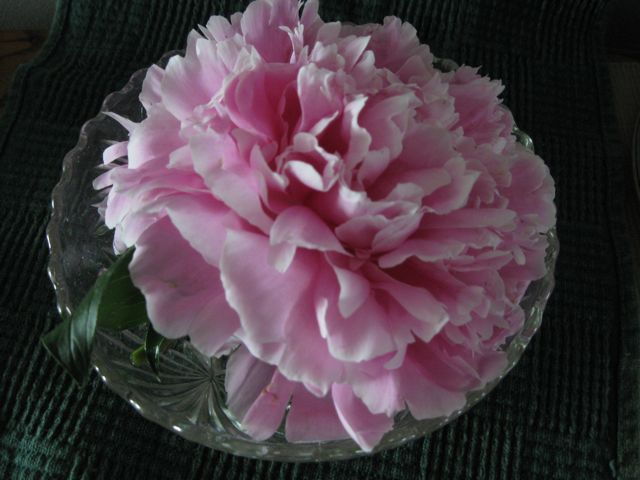
And on that stem was one incredibly gorgeous pink Peony bloom, large as a plate and perfect in every way. I’m not sure if that one exquisite flower was a reward or a remonstration, but it made me think about writing and how easy it is to give up on our work if it doesn’t get the desired response.

So, I’m going to dust off those manuscripts and take a good look at them. Maybe, just maybe, one of them will turn into a perfect bloom.One Perfect Bloom

The Cuckoo in the Bush

Recreating Your Travel

“It was our first full day in Rome. Jo and I sat at a tiny, outdoor table, nibbling on slabs of Pizza Margherita. The pizzeria was located in a cobbled-stoned alley near the Via del Corso, a neighborhood of small hotels and great shopping. “What is that strange noise?” Jo asked, washing down a bite of pizza with her cola.
“Oh,” I said wearily, “that’s just the cuckoo in the bush.”
She glanced over her shoulder and shrugged. Burrowed into a bush by the cafe door was a man whose hat, clothes, shoes, hair, hands and face were spray painted a shiny silver. His features were sharp–think Anthony Quinn in Zorba the Greek–and his eyebrows and handlebar mustache gleamed like a newly minted dime in the sunlight. He was swigging from a liter-sized bottle of beer and cooing in perfect imitation of the bird. We’d been in Rome for less than 24 hours and were so grateful to have a roof over our heads, the cuckoo in the bush could have been a nightingale in the moonlight for all we cared.”
This was how I began an account of a trip I took with my good friend, Joanne, a few months after I learned she had a serious illness and wouldn’t be taking any more trips with me. I wanted her to have it for the memory; but mostly, I wanted to make her smile.
My friend, Jo, was a flight attendant. We were flying “space available” to Rome.  Although we were listed, and the plane wasn’t fully booked, someone might come along with more seniority. So, bags packed, we met at the Dulles airport in D.C. I’d taken two flights from Kentucky to meet her, and she’d flown from the Pacific northwest.
Since we weren’t sure of the flight, we’d decided if we couldn’t get the flight to Rome, we’d go somewhere else. Maybe Frankfort. Maybe France. But, we would have a trip. We had euros; we had our passports; we had two weeks. It seemed enough.
Recently, I was talking about writing to a young man in my family. He has spent an incredible year abroad: teaching in Thailand, trekking in Nepal, walking the Camino de Santiago in Spain. He’s planning to write about his year, but told me he’d inadvertently lost his Nepal notes while bicycling in Paris. We discussed how he might begin his book.
“Recreate,” I said. “Forget about chronological order for the moment. Write scenes, descriptions, snatches of remembered conversations. Recall the sensation of taste, smell, sound, sight. Write as much as you can and don’t worry about how it will all fit. Weave it together after you find the predominating theme.”
As I wrote, and assembled remembered scenes about my trip with Joanne, the theme and title became obvious: Tuscany Without A Plan. Although I hadn’t taken notes on the trip–I was two busy driving our rental, 6-speed manual transmission Fiat and trying to keep us alive in traffic–I found it wasn’t hard to recreate our trip with the help of several maps, hotel and restaurant receipts, and a travel guide that would remind me of the correct names and spelling of the places we’d visited.
It’s really all you need; the humor, travails, joys and descriptions will not desert you. The people you met will come alive in your pages; the streets will invite you to walk them again; the sunset will thrill you anew.

Note: Long time between posts: A book fair, a workshop I presented on Oral History and the Art of Creative Eavesdropping, and a family medical issue has eaten up time. I promise to do better.

Cutting It Close

    You don’t have to win–or place–in a writing contest to reap a reward. True, it’s a thrill to receive a check, read your winning entry to an audience, or have it published.  But, for the moment, let’s consider the benefits of the process as well as the outcome.
I began sending in an occasional entry about ten years ago. My main objective was to have fun as opposed to the serious work of laboring over a manuscript. To that end, I’d pick a contest that required a small–if any–entry fee, assuming there might be hundreds, if not thousands, of entries and chances were slim.
Sometimes the publishers or organizations sponsoring the contest were looking for serious pieces; at other times it was all in jest. And, surprisingly, I won a few. The cash amounts I won were never over $150, although my work was published. The real payoff for me was learning to cut my material to meet page or word limits. Talk about editing! Try cutting 2463 words down to 750!
For an NPR Three-Minute-Fiction contest, I sent in a short piece, called Trucker,  that you can read at the end of this blog. It wasn’t chosen, but I found out how few words take up three minutes reading time.
The lesson I’ve learned? Entering contests, and adhering to the maximum word count requirement, is an effective way to achieve a tight, concise narrative. As writers, we face the dilemma of wanting to bring our scenes and characters alive with vivid description, yet avoid becoming verbose. It is a tough balance to achieve. Too much and the reader’s attention will stray; too little and your work seems shallow and sketchy.
Is there a fix, an automatic braking system that alerts you that you are off on a tangent, albeit an intriguing one?
For me, the discipline came from the contests and, astonishingly, allowed me to cut 80 pages from my latest novel. A publisher in our state ran a contest that limited manuscripts to 250 pages; I had 330. I trusted and respected the publisher, so I began hacking away at my manuscript. I went beyond their requirements and got it down to 244 pages. I didn’t win, but when I decided it was time to publish the novel, I pulled up both versions of the manuscript with the intention of putting back all the scenes I’d cut–details, descriptions, hundreds of words. To my amazement, they didn’t belong; didn’t work; detracted instead of embellished, and were better forgotten. In all, less than 10 pages made it back into the manuscript.
Want to try? Pick a contest; dig through some of the short stories, essays, or  stand-alone chapters you’ve already written; cut until you reach the required maximum page or word count. You may not win the top prize, but you will have gained an appreciable amount of expertise and discipline. Let me know how it works for you.

TRUCKER  (3 minute selection for NPR contest)

Laura stood in front of her car, cursing as the wind whipped the map from her hand and spun it into the air. She ran after it, but stopped when another strong gust swirled it across the interstate and into the prairie beyond. She heard the screech of brakes. A semi-truck come to a halt behind her car. The trucker jumped from the cab and rapidly covered the ground between them.
“Having trouble?”
“No, I’m fine. I’m just taking a break.”
“This is a bad time to stop. Radio said a blizzard’s on the way and it’s sixty miles to the next town. Sure you’re okay?”
“Yes. Really.”
“Well, you better get to Rawlins before dark. Won’t be long now. You don’t want to get caught in a storm out here.”
Laura looked in the direction her map had taken. The prairie stretched endlessly, flat and brown with grayish humps that she took to be sagebrush.
“Rawlins is the next town?”
The trucker hitched up his pants. His hat was pulled low and she couldn’t see his eyes.
“You don’t know where you are, do you?”
She couldn’t tell if he was smiling or smirking. He leaned back against the driver’s door. Laura looked in both directions, but there was nothing but empty highway. The sky was already darkening. The wind whipped her hair into her eyes. She pushed it away.
“You don’t, do you?” he insisted.
“It’s not a problem. I told you; I just stopped to stretch.”
“Looks to me you do have a problem if you don’t know where you are. There ain’t a gas station or a living soul between here and Rawlins.”
Laura felt the first snowflakes on her face. She tried to appear calm. If she could reach the passenger door, she could jump inside and hit the door lock.
“Do you want to follow me to Rawlins?”
“Huh?”
“Lady, you need to get to somewhere before the storm hits. You got a California plate. I’m bet you’ve never seen a Wyoming blizzard.”
Humor him, she thought. “ Okay. I’ll follow. Thanks.”
The trucker turned and walked back to his truck. Once safely inside her car, Laura felt the trembling begin. She wiped incipient tears from her eyes and waited for the truck lights to flare and the truck to pull away. Instead, the trucker was coming back. He tapped on the window, motioning for her to roll it down.
“No way,” she thought, then saw he was holding a thermos bottle. He pushed his cap back and mouthed the word “coffee.” She hesitated, then felt foolish for her fear. She rolled the window down and reached for the thermos. The hand that grasped her wrist was strong and sure

Channeling Camus or the First Paragraph Problem

In Albert Camus’s novel, The Plague, one of the characters, Joseph Grand, a middle-aged man in a government job, is writing–or attempting to write–a book. What gets in his way is that, as a perfectionist, he can’t seem to get the first sentence written to his satisfaction. So, he revises and rewrites it–over and over. For many writers, it is hard to get beyond that first paragraph because it is important. Frequently, concern over how to “start the book” crowds out great plot ideas or scenes that, if neglected, will become stale or forgotten.

I’d planned my first few blog entries to be on other writing topics, but, while eating a banana-walnut muffin at a hotel snack bar in Charleston, SC this past weekend, I began chatting with a man on the next stool. He is currently an executive who not only amassed several impressive degrees, but played a mean game of football. He said he’d been an English major in college. Talk turned to writing and what it took to write a novel. More specifically, where to begin.

My suggestion to him–and advice to myself–was to quit worrying about the first paragraph, first page, even the first chapter. True, they eventually have to be as good as you and all your rewriting can make them, but for the moment, what is the story you want to tell?

Sometime in the late 1990s, I picked up a copy of the Pulitzer Prize winning novel, The Stone Diaries, by Carol Shields. I was fascinated by the way she skipped from decade to decade, played with perspective, switched time and setting, and threw in newspaper announcements and other interesting bits germane to the story. And–it all worked so well!

I was putting together a nonfiction book at the time, and it was a liberating experience to see how interesting a book could be when the author strayed from a conventional, chronological format. My nonfiction book therefore has poetry, photos, and narratives. I’ve Carol’s work to thank for it.

So, back to that first paragraph. My advice to the gentleman at the snack bar was to develop characters, write scenes, write dialogue, write description. It doesn’t matter if it is only a few words, a few sentences, a few paragraphs. Write when the idea pops into your head. It’s hot and fresh then, and you will never write it quite so well six weeks later.

Keep writing until you have a collection, then sort it into an order that tells your story. If some don’t fit, save for another time. All you have to do to get started with your novel is know the story you want to tell.

How do you handle the first paragraph dilemma?

My First Straw

Why The First Straw?

It’s not uncommon, when frustrated or angry, to shout, “That’s the last straw!”
But what about the first straw? I never gave it any thought until I was digging into a bowl of soup and a hunk of bread one afternoon at a local sandwich shop. I wasn’t planning to eavesdrop, although I confess I do so at times. But that is a different type of eavesdropping, deliberate and with the purpose of getting a feel for “voice” and language patterns (not a bad idea for any writer of fictional dialogue).
This time, hearing the conversation at the booth adjacent to my table was unavoidable. An earnest young man was explaining his motivation for going to college to an older couple. Apparently the young man was just beginning his studies and was being sponsored–or at least advised–by the couple.
The prospective student launched into a description of why he’d left home and what had brought him to our university town.
“What I always wanted was a brother, a dog, and a real family–a home. But I didn’t get it. So, that was my can of beans.”
I perked up. Can of beans? Perfect. I love it when I hear someone describe something in unusual terms. Next, he said, “Had to call my stepmom Mamma Jane, but that just didn’t flow. You know, sounded like a restaurant with a woman’s name. That was the first straw.”
The cafe was crowded and I was getting pointed stares that said, “You are finished with your lunch. Get the hell out of here and let us have that table,” so I never heard what the student’s last straw was, but I couldn’t get the idea of a first straw out of my mind. What is the first straw, anyway? For me, it was a pointer to a new direction–that moment when I realized things had to change, and the responsibility for that change rested with me.
Since I write, and want to hear from writers–or those who are friendly to writers–I will share my first straw with you. No, it wasn’t the 38 rejections of my first novel; it wasn’t a publisher who cut my neat, 21 personal narratives book to 17 and left me to explain to four angry women why their stories wouldn’t be in the book when it came out. It wasn’t an editor who told me the memoir I’d written of my parents’ life on a sheep ranch in Wyoming was “unrealistic.” She thought she was reading a novel? It wasn’t even the publishers who said they loved my latest novel, but thought it was too regional. Well, okay, it was set in Kentucky, not Manhattan, but really?
No, my first straw was when an editor responded to my query letter by requesting that, instead of the usual sample chapter or two, she wanted the entire manuscript of my latest novel–all 350 pages. It was to be a hard copy, double spaced, one side only, and packaged just so. It  was expensive and cumbersome, but I sent it as requested. Afterall, not everyone likes to read from a computer screen, and I was under the illusion she intended to read it. Wrong.
On what had to have been the day she received it–unless some angel hand-carried it to her ten minutes after I dropped it off at the post office–she fired off an email that was so off the wall I question if she opened the package, let alone read the first few pages. My best guess is she had it confused with something she’d dreamed the night before.
That was my first straw, and that was when I decided to self-publish, even though I’m aware of all the drawbacks. I suspect we all have a first straw–a defining moment. What’s yours? Hit that first straw yet?